Dialogue Engine: Controlled Conversation on the Edge
Natural Interaction Without Loss of Control
Introduction
The Dialogue Engine enables natural language interaction while enforcing strict boundaries. Its purpose is not open-ended reasoning or autonomous planning, but reliable communication within predefined limits. A well-designed Dialogue Engine feels conversational yet remains predictable, auditable, and safe.
Design Goals
The Dialogue Engine is built to achieve:
– natural speech interaction
– identity-aware responses
– deterministic control paths
– explicit scope limitation
– graceful degradation when uncertain
Conversation quality must never compromise system safety.
Pipeline Overview
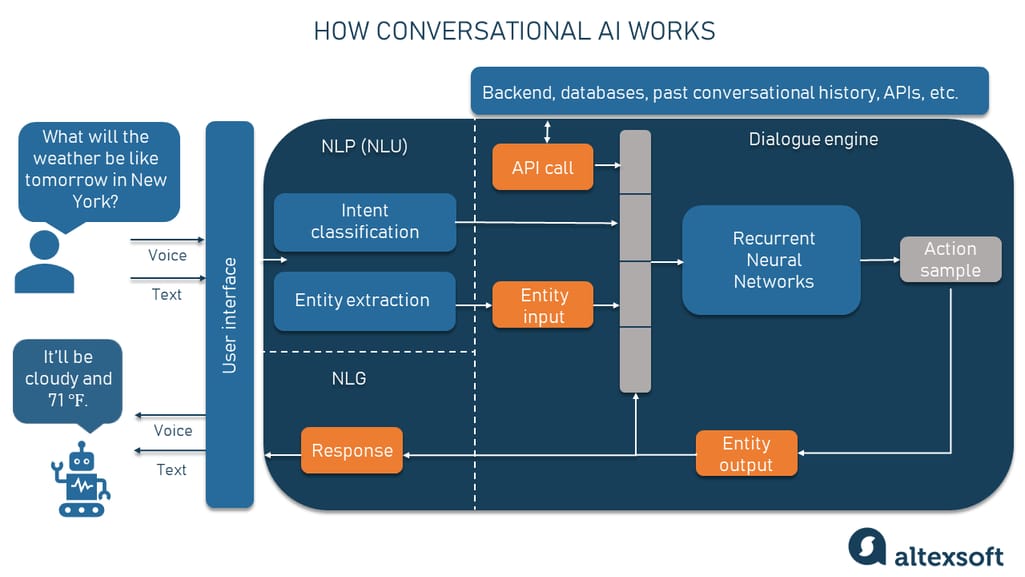
Dialogue processing follows a linear pipeline:
Audio Input → Speech-to-Text → Intent Extraction → Context Binding → Response Generation → Text-to-Speech
Each stage has clear inputs and outputs. No stage bypasses identity or scenario constraints.
Speech-to-Text
Speech recognition converts audio into text with confidence scores. Local models are preferred for privacy and latency; cloud-based STT may be used selectively as a fallback. Low-confidence transcripts are discarded or clarified rather than acted upon.
Intent Extraction
Intent extraction determines what the user wants, not how to execute it. Intents are categorized into a small, finite set:
– informational query
– command request
– conversational response
– system clarification
Free-form intent creation is explicitly forbidden.
Context Binding
Extracted intent is enriched with identity context from the Identity Engine and state context from the Scenario Engine. This step determines what information and actions are allowed. Context binding is where permissions are enforced, not later.
Response Strategy
Responses follow a tiered strategy:
1) Local deterministic response (status, greetings)
2) Local knowledge retrieval (cached facts, summaries)
3) External API query (LLM or search), if explicitly allowed
The Dialogue Engine never decides which tier to use arbitrarily; the scenario defines allowed tiers.
Use of Language Models
Language models are treated as external tools, not authorities. Prompts are structured, constrained, and identity-aware. Model output is post-processed and filtered before delivery. The assistant never exposes raw model output directly to the user.
Conversation Memory
Conversation memory is short-lived and contextual. Long-term memory is not stored in the Dialogue Engine. Persistent preferences and interests belong to the Owner profile, not to conversational logs. This avoids unintended profiling.
Clarification and Ambiguity
When intent confidence is low, the assistant asks clarifying questions or responds neutrally. Guessing is prohibited. A safe response is always preferred over a clever one.
Voice Output
Text-to-Speech uses predefined voice profiles per scenario or identity. Voice output reflects role and context but does not adapt dynamically based on emotional inference. Consistency builds trust.
Failure Modes
Common failures include background noise, overlapping speech, or ambiguous phrasing. The Dialogue Engine handles these by declining action, requesting repetition, or returning informational responses only. Failures never trigger automation.
Security Constraints
The Dialogue Engine enforces:
– no execution of commands without scenario approval
– no prompt injection propagation
– no identity override via conversation
– no hidden system state disclosure
All responses are traceable to a scenario and intent.
Testing and Validation
Dialogue behavior must be testable via text-only simulation. Audio is optional during development. Intent classification, context binding, and response filtering should be validated independently before full integration.
Integration with Other Engines
The Dialogue Engine consumes identity and scenario context and produces bounded responses. It does not modify identity, scenarios, or automation rules. Control always returns to the Scenario Engine.
What Comes Next
With controlled conversation in place, the next article introduces the Information and Knowledge Engine: news retrieval, topic filtering, summarization, and owner-personalized information flows.